
🇯🇵 Japan’s Men’s Global Wellbeing Index: Tradition, Safety, and a Silent Strain
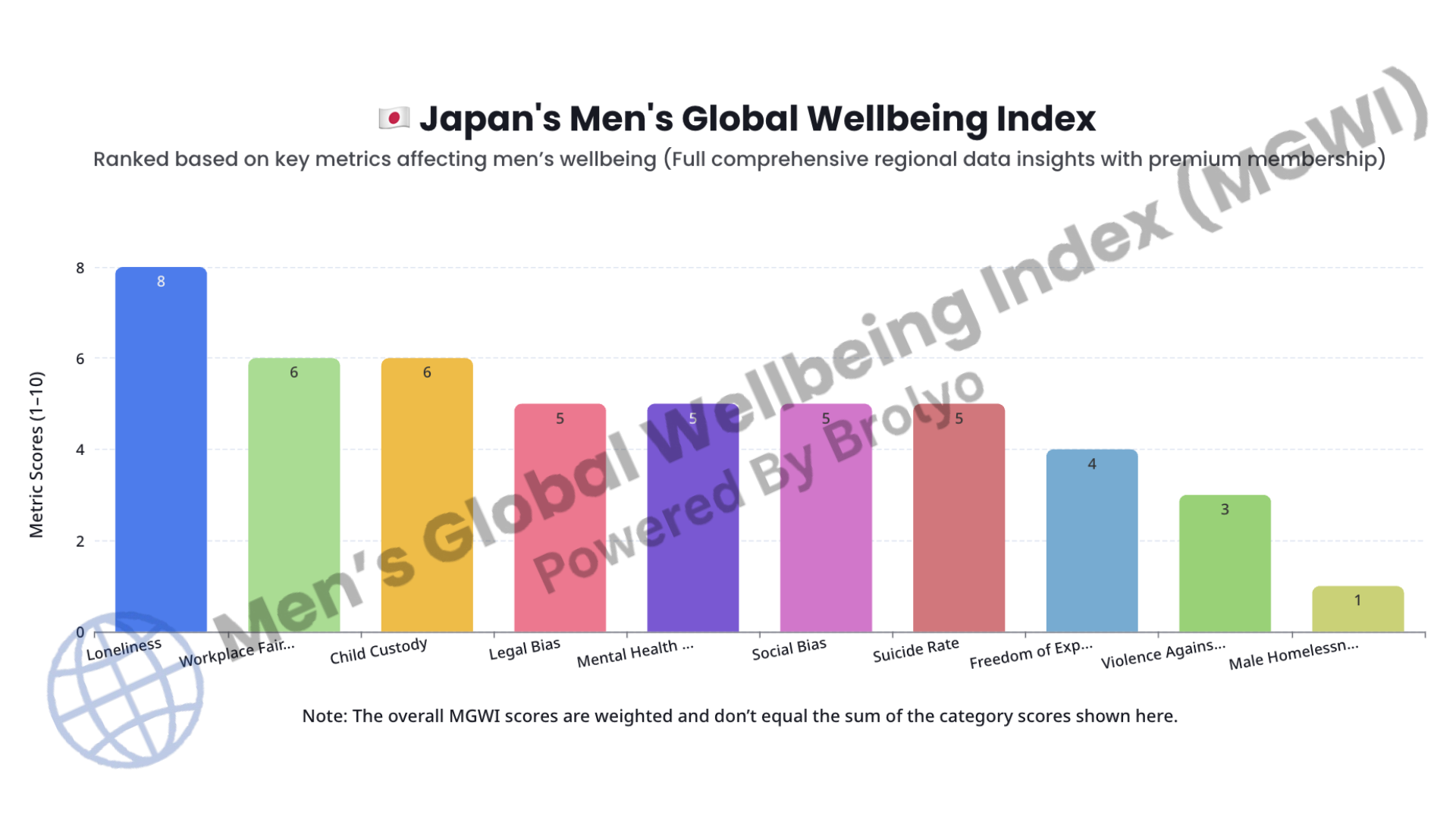
Japan blends centuries-old tradition with world-class modernity. From Tokyo’s relentless pace to Kyoto’s quiet temples, men in Japan benefit from social order, safety, and opportunity. Yet beneath the surface, work pressures, family-law realities, and isolation shape a more complicated picture. The Men’s Global Wellbeing Index (MGWI) captures these contrasts across ten dimensions: suicide, legal bias, homelessness, social bias, child custody, workplace fairness, freedom of expression, mental health access, violence against men, and loneliness. With an overall score of 48/100, Japan ranks mid-range globally—strong in safety and stability, but weighed down by emotional and structural pressures.
Suicide Rate: Persistent but Moderated (Score: 5)
Japan continues to wrestle with male suicide. In 2023, 21,818 suicides were recorded, roughly 70% involving men. Prevention efforts and awareness have helped avoid historic peaks, but stigma and economic or social pressures keep risk elevated—especially for middle-aged and younger men.
Legal Bias & Child Custody: Reform on the Horizon (Scores: 5 & 6)
Japan passed a landmark law in May 2024 to allow joint custody after divorce—the first major shift in decades. However, it won’t take effect until 2026, and current practice still often disadvantages fathers in custody arrangements. Until implementation reshapes outcomes, men’s lived experience remains mixed.
Homelessness: Rare but Not Invisible (Score: 1)
Japan’s visible homelessness is among the lowest in the OECD, with government counts around 3,000 nationwide—partly due to effective outreach and social order. Still, “hidden” homelessness exists (e.g., net-café living), reminding us that low street counts don’t eliminate vulnerability.
Social Bias: Conformity and Role Expectations (Score: 5)
Based on our research using a Financial Times article, Strong cultural expectations about masculinity—breadwinner identity, endurance, and harmony shape men’s choices and willingness to seek help. These norms intersect with work culture and isolation, amplifying stress for some.
Workplace Fairness: Progress vs. Karoshi Legacy (Score: 6)
Work-style reforms and hotlines exist, and average hours are edging down, but long hours, unpaid overtime, and labor shortages keep pressure high. Younger workers are pushing back, yet implementation remains uneven across sectors.
Freedom of Expression: Free, with Caveats (Score: 4)
Japan is rated “Free” by Freedom House, reflecting strong civil liberties. Still, its 2024 press-freedom ranking slipped to 70th, signalling concerns about media environment and access, even as day-to-day expression remains broadly protected.
Mental Health Access: Capacity Meets Stigma (Score: 5)
Japan has meaningful mental-health infrastructure, but cultural reluctance to seek care limits uptake among men. Expanding male-friendly entry points and normalizing help-seeking are essential next steps.
Violence Against Men: Low by Global Standards (Score: 3)
Despite a recent rise toward pre-pandemic crime levels, Japan remains one of the world’s safest countries, with comparatively low violent crime affecting men. Underreporting of domestic or workplace abuse still deserves attention.
Loneliness: The Standout Challenge (Score: 8)
Isolation is Japan’s most acute issue for men. Roughly 39% of residents report feeling lonely, and Japan has enacted a law specifically to counter loneliness and social isolation—clear recognition of the scale of the problem.
Japan’s MGWI in Global Context
At 48/100, Japan’s strengths—low homelessness, personal safety, and legal stability—are offset by loneliness, work-related stress, and family-law frictions not yet relieved by pending reforms.
Driving Change in Japan
What moves the needle? Implement the joint-custody reform effectively; deepen work-style changes beyond headline policies; scale community-building and men-friendly mental-health services. Reducing stigma and broadening support networks can convert Japan’s social order into genuine wellbeing for men.
📊 Japan MGWI Score: 48/100
Strengths: Low homelessness, safety, legal stability
Challenges: Loneliness, work pressure, suicide risk
💡 If you found this research valuable, consider supporting our work. Even a small donation helps us expand the Men’s Global Wellbeing Index and reach more people. Donate here.