
Men’s Wellbeing in Louisiana — MGWI Score: 44/100
The Men’s Wellbeing Index Score in the State of Louisiana, highlights several critical issues facing men in the state.
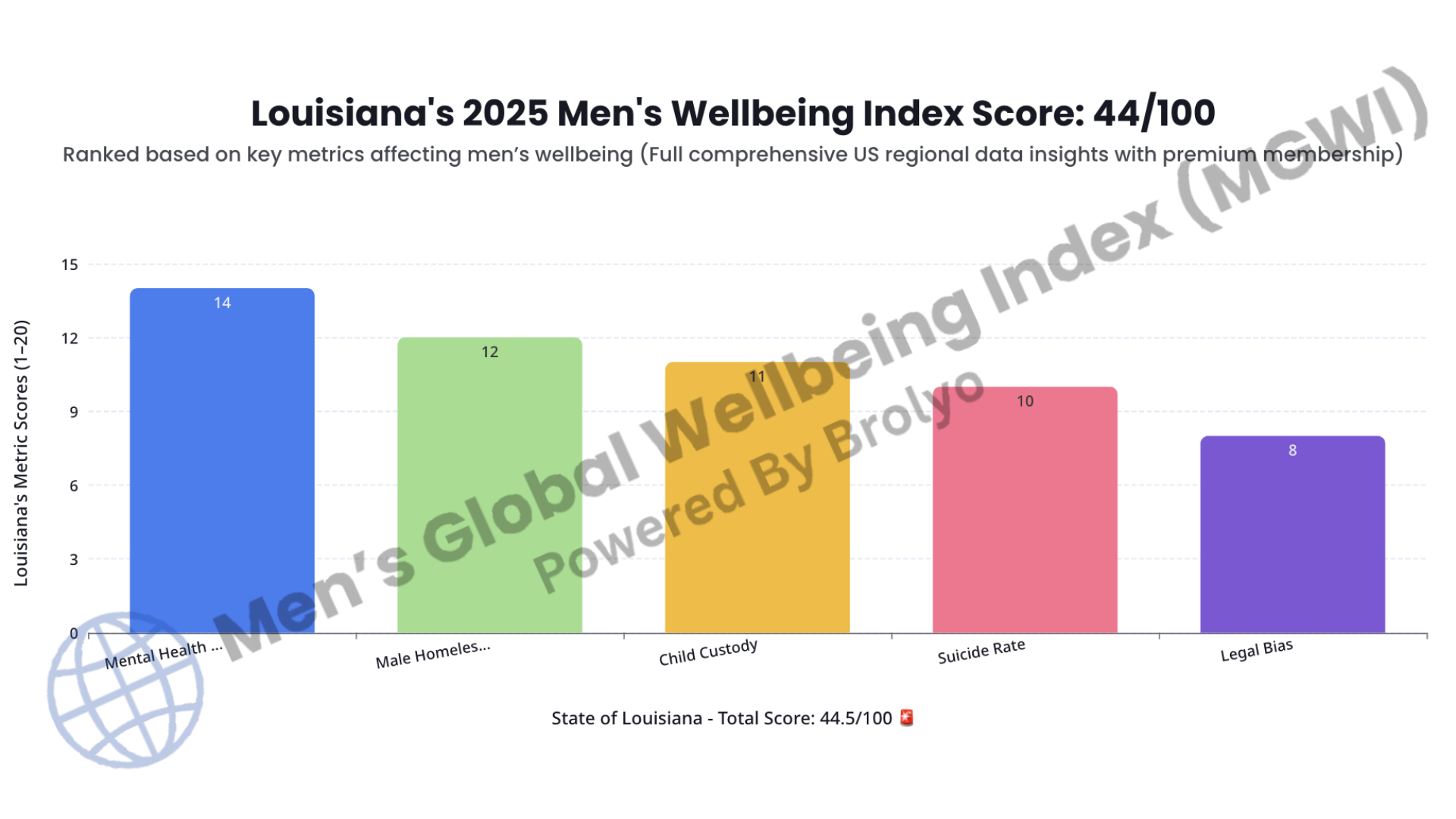
Using five core metrics — Suicide Rate, Male Homelessness, Mental Health Access, Child Custody, and Legal Bias — Louisiana earns an overall score of 44 out of 100, placing it in the lower tier compared to other U.S. states.
Each metric is scored on a scale from 1 to 20, where 1 reflects the greatest challenge and 20 the most positive outcome. Louisiana’s results reveal a pattern of interconnected struggles — from limited mental health care to systemic legal imbalances — that directly affect men’s wellbeing.
1. Suicide Rate — Score: 10/20
Louisiana’s male suicide rate remains a pressing concern. With a score of 10, the state performs below the national average, signaling a need for stronger suicide prevention measures. Men in Louisiana often face cultural and societal pressures to remain stoic, which can discourage them from seeking help early. Economic instability, relationship breakdowns, and untreated mental health conditions add further risk.
While some community-based programs exist, coverage is patchy — especially in rural areas — making it difficult for men in crisis to find immediate and affordable support.
2. Male Homelessness — Score: 12/20
Louisiana scores 12 for male homelessness, indicating moderate but still significant concern. Homelessness among men in the state is often linked to unemployment, addiction, mental illness, and family breakdowns.
Men who become homeless frequently encounter barriers to shelter services, as many facilities prioritize women and children. Without stable housing, it becomes much harder to secure work, reconnect with family, or access healthcare, creating a cycle that is difficult to break without targeted intervention.
3. Mental Health Access — Score: 14/20
Mental health access in Louisiana is improving just 14 out of 20 but still fall short of national average as it reflects an urgent gap in the state’s support system. Men face multiple hurdles when trying to access mental health care: long wait times, shortages of licensed professionals, and high out-of-pocket costs for therapy.
For men in rural or economically disadvantaged areas, these barriers are even greater. Limited availability of male-focused mental health services means that many men simply go without treatment until issues escalate to crisis levels.
4. Child Custody — Score: 11/20
Louisiana earns a score of 11 for child custody fairness. While there are fathers who successfully gain shared parenting arrangements, many still face systemic and cultural barriers. Courts may lean toward granting primary custody to mothers, even in cases where both parents are equally capable caregivers.
This imbalance not only affects fathers but also impacts children, who benefit from strong, ongoing relationships with both parents. Legal reforms and public education about the benefits of shared parenting could help improve this score over time.
5. Legal Bias — Score: 8/20
Legal bias remains the most significant concern for men in Louisiana earning the states lowest score of 8 out of 20 in this category. Men often perceive and in some cases, experience unequal treatment in family courts, sentencing, and certain areas of criminal law.
Whether through harsher penalties, assumptions about men’s intentions, or limited access to quality legal representation, these disparities undermine confidence in the justice system. Ensuring fair, evidence-based decisions across the board would help reduce this bias.
The Bigger Picture
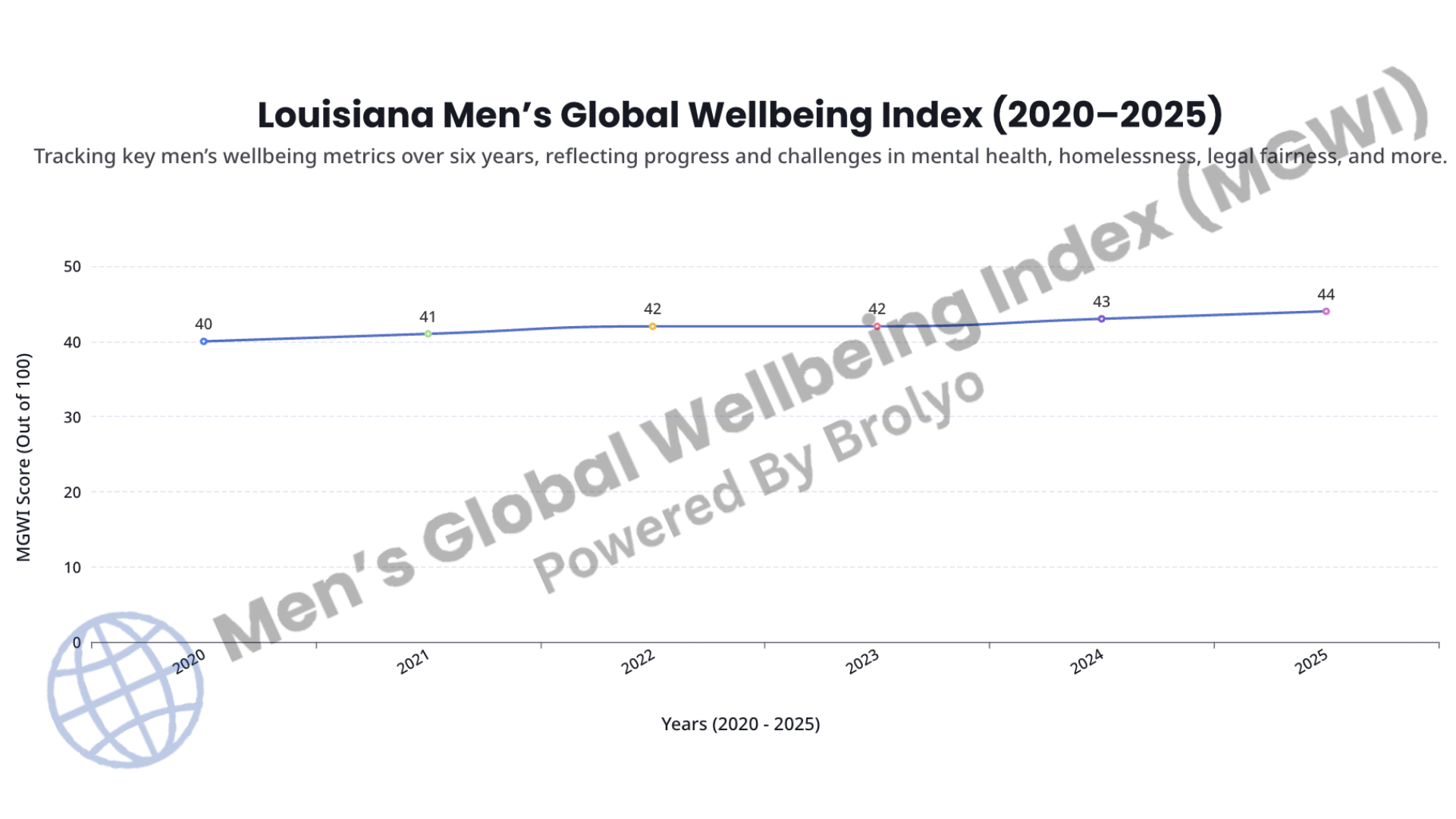
Louisiana’s overall MGWI score of 44 out of 100 is more than just a number — it’s a reflection of overlapping issues that affect men’s health, stability, and relationships.
For example:
- Lower than national average mental health access (14/20) feeds into higher suicide rates (10/20).
- Custody and legal bias (11/20 and 8/20) can exacerbate emotional distress and financial instability.
- Homelessness (12/20) can be both a cause and a consequence of these other struggles.
Addressing these challenges requires coordinated action from policymakers, community organizations, and health providers. Other states have improved their MGWI scores by:
- Expanding male-focused mental health outreach programs.
- Providing transitional housing options specifically for men.
- Reforming custody laws to make equal parenting time the default.
- Increasing funding for legal aid programs for low-income men.
Conclusion
Men in Louisiana are navigating a landscape with uneven support systems, where legal fairness, mental health care, and family relationships often come under strain. While the state shows moderate performance in homelessness prevention, it struggles significantly with suicide rates and systemic legal bias in the courts.
The MGWI exists to shine a light on these issues, not as criticism but as a call to action. With targeted reforms and community-level engagement, Louisiana could see its score rise — and more importantly, see measurable improvements in the day-to-day lives of men across the state.
💡 If you found this research valuable, consider supporting our work. Even a small donation helps us expand the Men’s Global Wellbeing Index and reach more people. Donate here.